Table of Contents
- •1. Immersion Is at the Heart of VR
- •2. Interaction Should Feel Natural
- •3. Movement Must Be Comfortable
- •Teleportation
- •Smooth locomotion
- •Room-scale movement
- •Snap turning
- •4. The Game Needs to Be Fun Without the VR Gimmick
- •5. Presence Makes Small Details Important
- •6. Physics Can Make the World Feel Alive
- •7. Audio Is More Important Than Many Players Realise
- •8. The Player's Hands Should Matter
- •9. Responsiveness Is Critical
- •10. Good VR Games Understand the Player's Physical Space
- •11. Multiplayer Can Make VR Extraordinary
- •12. The Game Should Teach Players Without Overwhelming Them
- •13. Accessibility Matters
- •14. Graphics Should Serve the Experience
- •15. A Great VR Game Has a Strong Sense of Scale
- •16. The Best VR Games Make the Player Feel Like They Are Doing Something
- •17. VR Should Create Experiences That Traditional Games Cannot
- •18. The Secret Is Balance
- •Conclusion
What Makes a Good VR Game?
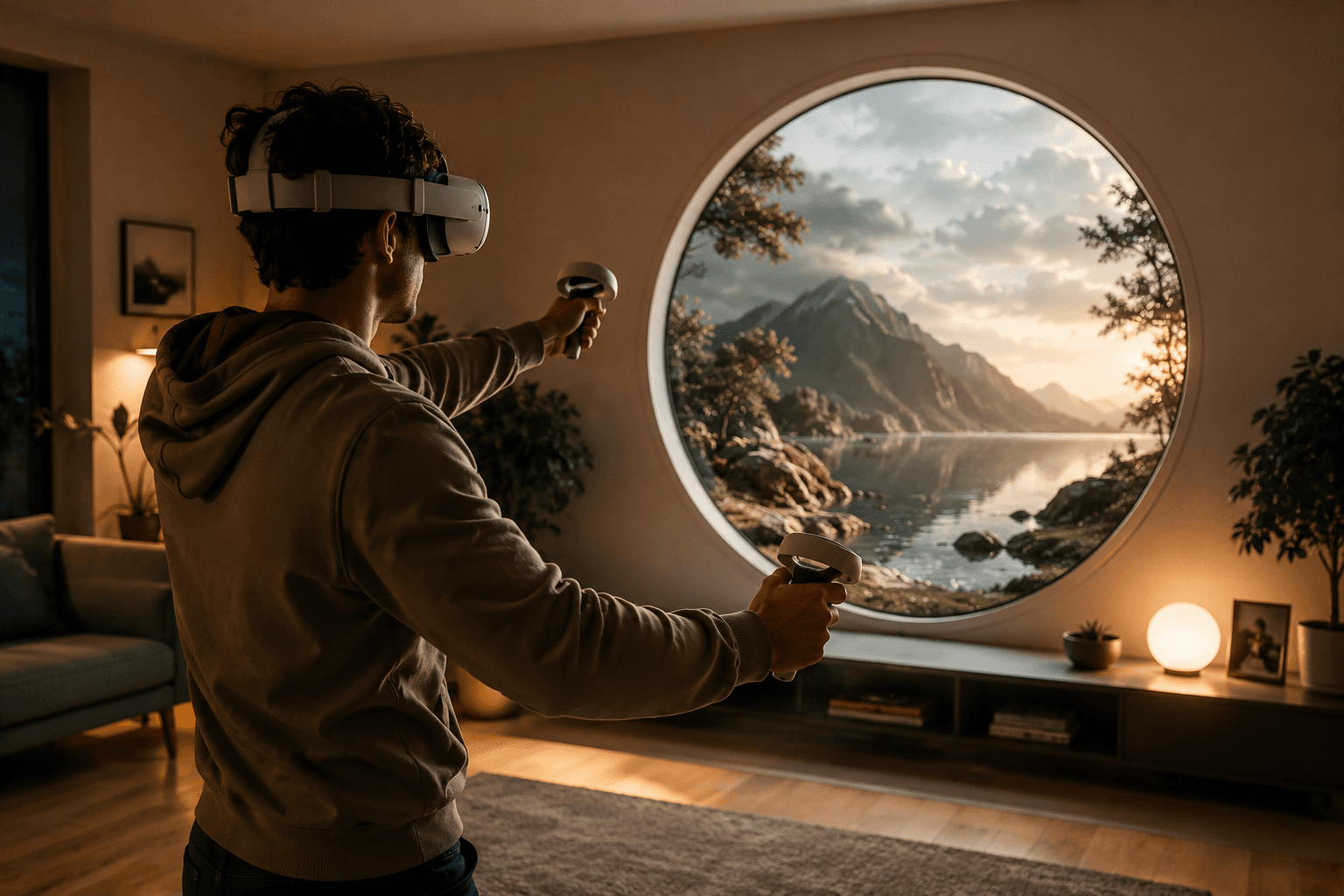
Virtual reality has changed the way people experience games. Instead of sitting outside the game world and controlling a character from a screen, players can step inside the experience, look around, interact with objects, and physically participate in the action. This makes VR fundamentally different from traditional gaming. A good VR game therefore cannot simply take a conventional game and place it inside a headset. It needs to be designed around what makes virtual reality unique.
So, what actually makes a VR game good? The answer goes far beyond impressive graphics. A great VR game combines immersion, intuitive interaction, meaningful gameplay, comfort, responsiveness, audio, accessibility, and a strong sense of presence. When these elements work together, players stop thinking about the technology and start feeling like they are actually inside another world.
1. Immersion Is at the Heart of VR
The biggest advantage of virtual reality is immersion.
On a traditional screen, the player looks at a game world through a rectangular window. In VR, the game surrounds the player. They can turn their head, look behind them, examine objects from different angles, and physically interact with their environment.
This creates a powerful sense of presence — the feeling that you are actually inside the virtual environment.
A good VR game takes advantage of this rather than treating VR as simply another display.
Imagine playing a horror game. On a television, you might see something moving behind your character. In VR, you can physically turn around and discover that the creature is standing only a few metres away. The emotional impact can be significantly stronger because your brain is responding to the environment as something you are personally experiencing.
Immersion can come from many things:
- A believable environment
- Realistic object interaction
- Spatial audio
- Natural movement
- Environmental details
- Appropriate lighting
- Responsive physics
- Characters that react to the player's actions
However, immersion does not necessarily require photorealistic graphics. A stylised game can be incredibly immersive if its world is consistent and responsive.
The key principle is simple:
The virtual world should behave in a way that makes sense to the player.
2. Interaction Should Feel Natural
One of the biggest differences between VR and traditional games is interaction.
On a traditional controller, a player might press a button to pick something up. In VR, they can potentially reach out with their hand, grab the object, move it around, throw it, inspect it, or use it.
This is where VR becomes particularly powerful.
A good VR game should allow players to interact with the environment in ways that feel natural.
For example, if a player finds a drawer, it should ideally feel like a drawer. The player should be able to reach toward it, grab the handle and pull it open. If they find a bottle, they should be able to pick it up and examine it.
These interactions create a connection between the player's physical actions and the virtual world.
Poor interaction can have the opposite effect. If a player tries to grab an object but has to press an unintuitive button or position their controller in an unnatural way, the illusion can immediately disappear.
This means VR developers need to think carefully about interaction design.
The question should not simply be:
"What button should the player press?"
Instead, developers should ask:
"What would a person naturally do with this object in the real world?"
That difference is fundamental to good VR design.
3. Movement Must Be Comfortable
Movement is one of the most challenging aspects of VR game development.
In a traditional game, a player can move a character quickly across a huge environment without feeling physically affected. In VR, the player's eyes may tell their brain that they are moving while their inner ear tells them that their body is standing still.
This mismatch can cause motion sickness, dizziness, nausea, or discomfort.
A good VR game therefore needs to give players movement options that suit different comfort levels.
Common VR movement systems include:
Teleportation
The player points toward a location and instantly moves there.
This is often comfortable for players who are sensitive to motion.
Smooth locomotion
The player uses the controller's joystick to move continuously through the environment.
This can feel more natural but may be uncomfortable for some players.
Room-scale movement
The player physically walks around a designated play area while moving around the virtual environment.
This can be extremely immersive but is limited by the player's physical space.
Snap turning
Instead of smoothly rotating the camera, the player turns in fixed increments.
This can reduce discomfort for some players.
A strong VR game does not assume that every player experiences VR in the same way. Giving players movement and comfort options can dramatically improve the experience.
4. The Game Needs to Be Fun Without the VR Gimmick
One of the biggest mistakes a VR developer can make is designing a game around the idea:
"This is cool because it's VR."
That may be enough to impress someone for a few minutes, but it is not enough to create a great game.
VR should enhance the gameplay rather than replace it.
A good VR game needs a compelling gameplay loop.
For example:
Explore → Discover → Interact → Solve → Progress → Repeat
Or:
Fight → Collect → Upgrade → Become stronger → Fight harder enemies
The player should have a reason to continue playing beyond simply experiencing the technology.
This is especially important for developers creating VR experiences for events, entertainment venues, or businesses. A player might be impressed by putting on a headset, but the experience becomes much more memorable when there is an actual objective.
The player might need to:
- Defeat enemies
- Solve puzzles
- Find hidden objects
- Escape from a dangerous environment
- Work together with friends
- Complete challenges
- Build something
- Explore an unfamiliar world
- Beat a high score
The VR technology gets people interested.
Good gameplay keeps them playing.
5. Presence Makes Small Details Important
VR creates a strange but powerful phenomenon: small details can become extremely noticeable.
In a traditional game, a player might ignore a table in the corner of a room. In VR, they can walk toward it, look underneath it, pick up objects from it, or inspect its surface.
This means developers can create immersion through environmental details.
Consider a virtual kitchen.
A developer could simply create a kitchen with cupboards, a refrigerator and a stove.
Or they could make the environment interactive:
- Open the refrigerator.
- Pick up a bottle.
- Open cupboards.
- Turn on the tap.
- Move plates.
- Throw objects into the sink.
- Switch the lights on and off.
- Look through drawers.
Suddenly, the environment feels less like a background and more like a place.
This is one of VR's greatest strengths.
6. Physics Can Make the World Feel Alive
Physics is another major component of good VR design.
Objects should generally respond to the player's actions in believable ways.
If a player throws a ball, it should travel through the air.
If they knock over a bottle, it should fall.
If they stack objects, the objects should interact with one another.
If they push something heavy, it should behave differently from something light.
These interactions create a sense of physicality.
However, realistic physics alone are not enough. The physics should also support gameplay.
For example, imagine a puzzle where a player needs to place objects on a scale. The player can physically manipulate those objects, experiment with different combinations, and observe how the scale reacts.
The physics become part of the gameplay rather than simply being a visual effect.
7. Audio Is More Important Than Many Players Realise
VR is visual, but sound is equally important for creating presence.
Spatial or 3D audio allows players to determine where sounds are coming from.
A player might hear footsteps behind them and instinctively turn around.
They might hear something fall in another room.
They might hear a voice approaching from the left.
They might hear an enemy moving above them.
These sounds can make the virtual environment feel much larger than what the player can currently see.
Audio can also be used to communicate information.
Instead of displaying:
"Enemy approaching."
the game can allow the player to hear footsteps getting closer.
This is more immersive because the information exists naturally within the virtual world.
For horror games in particular, sound can be more effective than visual effects. Sometimes what the player hears but cannot see is more frightening than what they can see directly.
8. The Player's Hands Should Matter
VR controllers essentially become the player's hands.
Good VR games take advantage of this.
Players should be able to perform actions such as:
- Grab
- Push
- Pull
- Throw
- Aim
- Point
- Press
- Twist
- Pick up
- Hold
- Manipulate
The more meaningful these actions become, the more connected the player can feel to the virtual world.
However, developers should avoid adding unnecessary interaction simply because they can.
If the player needs to press five buttons just to open a door that could have been opened by turning a handle, the interaction may become frustrating rather than immersive.
Good VR interaction is usually simple, responsive and purposeful.
9. Responsiveness Is Critical
In VR, even small delays can be noticeable.
When a player moves their hand, the virtual hand should respond quickly.
When they turn their head, the environment should follow naturally.
When they interact with an object, the game should respond immediately.
This is because VR is closely connected to physical movement. The player expects a strong relationship between what their body does and what they see.
If that relationship breaks, immersion can disappear.
Performance therefore matters enormously.
A good VR game needs to maintain stable performance and minimise latency. This is particularly important on standalone headsets, where developers have limited processing power compared with high-end gaming PCs.
The developer has to balance:
Visual quality + physics + lighting + AI + environment complexity + frame rate + headset limitations
A beautiful game that makes the player uncomfortable is not a good VR game.
10. Good VR Games Understand the Player's Physical Space
Unlike traditional games, VR games exist partly inside the player's physical environment.
This introduces another design challenge.
A player might have:
- A large play area
- A small bedroom
- A living room
- A commercial VR arena
- An outdoor event space
The game cannot always assume the player has unlimited room.
Developers should therefore consider boundaries and physical safety.
A good VR experience should avoid encouraging players to:
- Walk into walls
- Swing controllers into furniture
- Move outside the safe play area
- Perform dangerous physical movements
- Turn excessively without considering cables or surroundings
This is particularly important for multiplayer and event-based VR.
When several people are playing at the same time, physical space becomes part of the overall system design.
11. Multiplayer Can Make VR Extraordinary
VR becomes even more powerful when players can share the same experience.
Imagine putting on a headset and seeing your friend standing beside you inside a virtual world.
You can point at something.
You can hand them an object.
You can work together to solve a puzzle.
You can fight alongside them.
You can communicate naturally.
These interactions can create memorable experiences.
Multiplayer VR can be especially effective for:
- Team-building
- Parties
- Events
- Education
- Competitive gaming
- Social experiences
- Arcade environments
However, multiplayer VR also introduces additional technical challenges, including networking, synchronisation, voice communication, player tracking and latency.
A great multiplayer VR game must make players feel as though they genuinely share the same space.
12. The Game Should Teach Players Without Overwhelming Them
Traditional games often rely on menus, tutorials and button prompts.
VR requires a slightly different approach.
A player may not know how to interact with an object, but instead of showing a long tutorial, the game can teach through the environment.
For example, the game could place a door in front of the player.
The player naturally reaches for the handle.
They pull it.
The door opens.
The player has just learned the game's interaction system without reading a manual.
This is known as environmental learning.
The best VR tutorials often allow players to learn by doing.
Instead of telling the player:
"Press the trigger button to grab an object."
the game can place a useful object nearby and encourage the player to experiment.
The player learns the mechanic naturally.
13. Accessibility Matters
Not everyone interacts with VR in the same way.
Players can have different levels of gaming experience, physical ability, spatial awareness and tolerance for motion.
A good VR game should provide options wherever possible.
Useful accessibility features can include:
- Adjustable movement speed
- Teleportation
- Snap turning
- Smooth turning
- Seated play
- Standing play
- Left-handed controls
- Adjustable difficulty
- Subtitles
- Visual indicators
- Customisable controls
- Comfort settings
Accessibility does not necessarily make a game less immersive.
In many cases, it makes the game accessible to a much larger audience.
14. Graphics Should Serve the Experience
It is tempting to believe that the best VR game is the one with the most realistic graphics.
That is not necessarily true.
VR graphics need to support immersion while maintaining performance.
A developer might have to choose between:
Extremely detailed environment + poor performance
and
Stylised environment + smooth performance
The second option may produce a much better experience.
This is why artistic direction matters.
A stylised VR game can look fantastic while requiring fewer resources than a photorealistic game.
The goal is not simply:
"Make everything realistic."
The goal is:
"Make everything believable within the game's world."
15. A Great VR Game Has a Strong Sense of Scale
VR allows players to experience scale in a way that traditional games cannot replicate as effectively.
A huge creature standing directly in front of the player can feel genuinely enormous.
A tiny object sitting in the player's hand can feel surprisingly small.
A massive building can make the player feel insignificant.
This can be used deliberately to create emotional impact.
Imagine entering a virtual space and looking up at a structure hundreds of metres tall.
The player does not merely see its size on a screen.
They experience its size relative to their own body.
This makes scale an extremely powerful VR design tool.
16. The Best VR Games Make the Player Feel Like They Are Doing Something
One of the most important differences between traditional games and VR is the player's physical involvement.
In a traditional game, the player might watch a character perform an action.
In VR, the player can potentially perform the action themselves.
That distinction is extremely important.
Instead of watching a character open a safe, the player can physically turn the combination dial.
Instead of watching a character throw a grenade, the player can physically throw it.
Instead of watching someone shoot an arrow, the player can pull the bowstring and release it.
Instead of watching someone repair a machine, the player can physically manipulate its components.
The player is no longer simply controlling a character.
The player becomes part of the interaction.
17. VR Should Create Experiences That Traditional Games Cannot
This may be the most important principle of all.
A developer should always ask:
"Why does this need to be VR?"
If the answer is simply that the game looks better inside a headset, the concept may not be taking full advantage of the medium.
A strong VR concept should use things such as:
- Physical interaction
- Spatial awareness
- Hand tracking
- Presence
- Scale
- Immersive environments
- Real-world movement
- Spatial audio
- Social interaction
For example, a puzzle game that requires the player to physically manipulate objects in three-dimensional space makes sense in VR.
A game that simply involves looking at a traditional HUD while pressing buttons may not benefit nearly as much from VR.
The best VR games are often experiences that would be difficult, impossible, or fundamentally different to play on a normal screen.
18. The Secret Is Balance
Ultimately, no single feature makes a VR game great.
Amazing graphics are not enough.
Realistic physics are not enough.
Multiplayer is not enough.
Immersion is not enough.
The strongest VR games balance multiple systems together.
A useful way to think about it is:
Good VR Game = Immersion + Interaction + Gameplay + Comfort + Performance + Audio + Accessibility + Purpose
If any one of these is seriously neglected, the experience can suffer.
For example:
Great graphics + poor gameplay = beautiful but boring.
Great gameplay + poor comfort = fun but difficult to play.
Great interaction + poor performance = immersive but frustrating.
Great technology + no meaningful objective = impressive but forgettable.
A great VR game brings everything together.
Conclusion
A good VR game is not simply a traditional game viewed through a headset. It is an experience designed around the unique relationship between the player's body, the virtual environment and the game mechanics.
The strongest VR games make the player feel present. They allow players to reach out, interact, explore, solve problems and physically participate in the world. They provide comfortable movement, responsive controls, convincing audio, meaningful gameplay and environments that react naturally to the player's actions.
Most importantly, a good VR game gives the player a reason to care about what happens inside the virtual world.
The technology may be what gets someone to put on the headset.
But immersion, interaction and great gameplay are what make them want to keep it on.
Ready to bring Virtual Reality to your next event?
We supply premium mobile VR packages, gaming catalogues, and complete event coordination in Cape Town and surrounding areas.